
Overview & Strategic Context
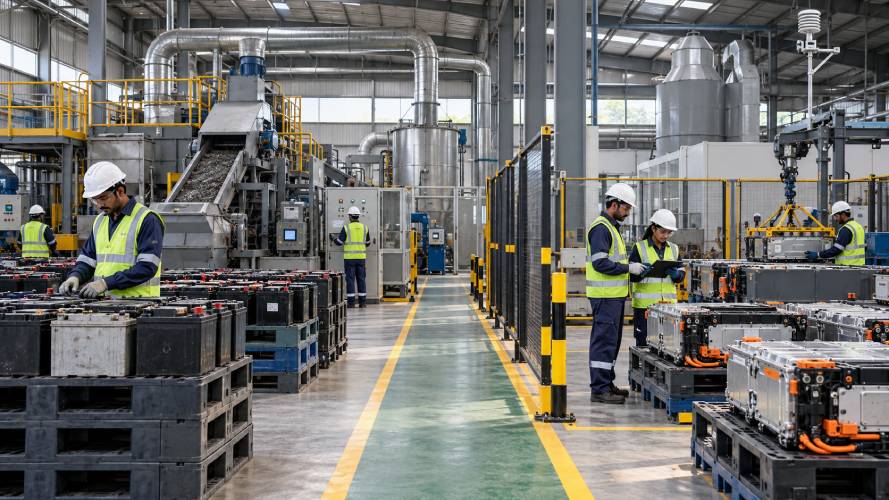
With the acceleration of electric mobility and grid-scale renewable energy storage, battery waste recycling is critical to India's national mineral security. Spent batteries contain strategic critical minerals—lithium, cobalt, nickel, and manganese—that are scarce in natural reserves. Under the Battery Waste Management Rules (BWMR), Shree Alliance has established a closed-loop processing plant capable of safely discharging, shredding under inert atmosphere, and extracting premium battery-grade precursor chemicals.
Technical Process & Circular Recovery Flow
Automated Deep Discharge & Diagnostics
Safe electrical dissipation of residual charge into captive storage systems, preventing short circuits and thermal runaway.
Inert Atmosphere Shredding & Delamination
Nitrogen-blanketed hammer milling preventing fire risks while separating electrolyte solvents and polymer separators.
Black Mass Mechanical Concentration
Multi-stage sieving separating high-grade Black Mass (cobalt, lithium, nickel, graphite) from aluminum and copper current collectors.
Hydrometallurgical Metal Extraction
Acid leaching and selective solvent extraction synthesizing battery-grade Lithium Carbonate, Cobalt Sulfate, and Nickel Sulfate.
Key Recovered Materials & Commercial Outputs
Statutory Compliance & EPR Framework
Regulatory Standards: Full CPCB BWMR compliance, Extended Producer Responsibility credits for EV OEMs and battery importers, and zero liquid discharge facility.