
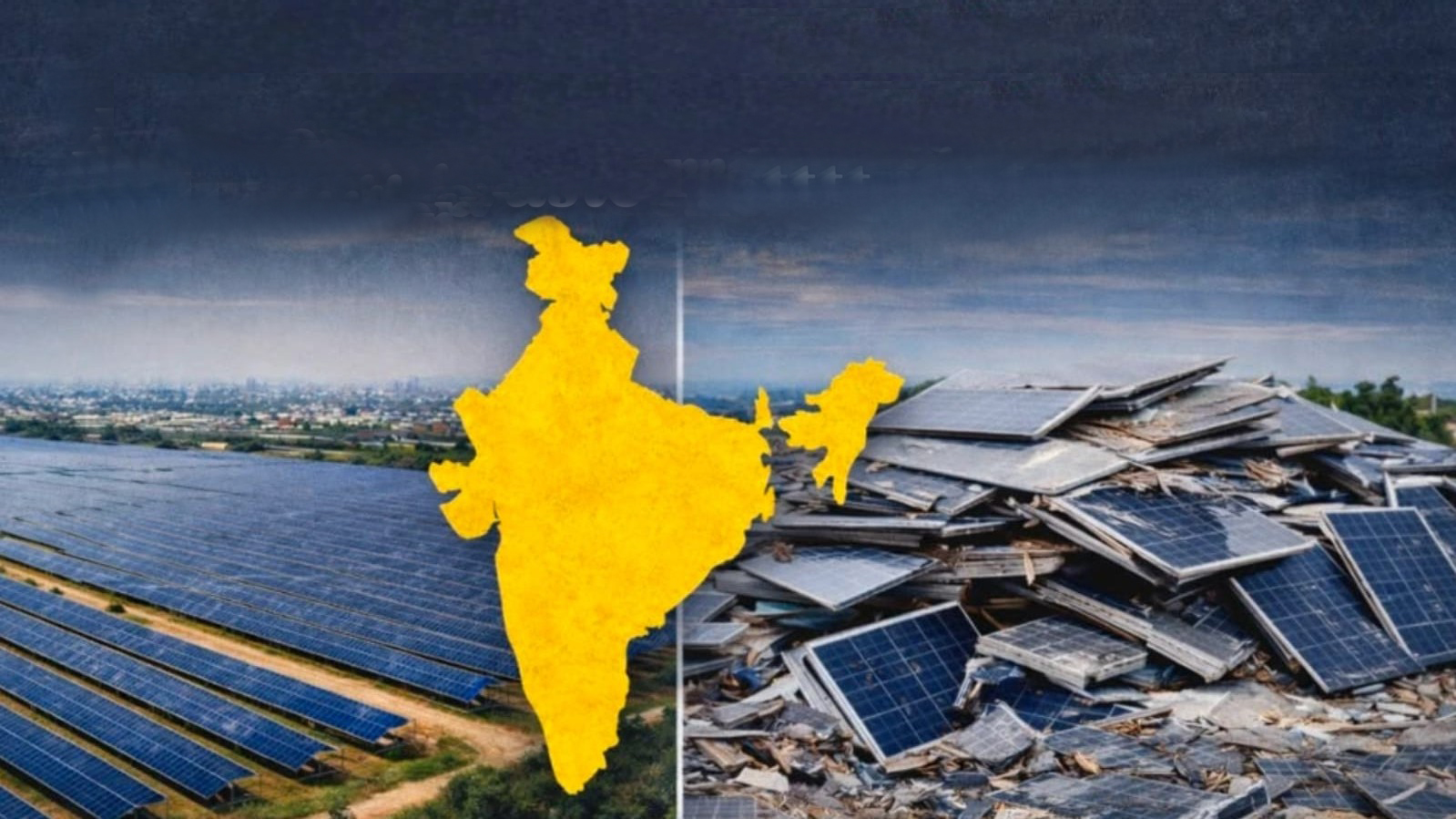
India’s solar revolution is nothing short of extraordinary. With over 168 GW of cumulative solar installations across the country, solar farms have transformed vast landscapes into green energy powerhouses. However, every solar module manufactured today carries a finite operational lifecycle of 20 to 25 years.
The Looming Waste Mountain
According to recent projections by the International Renewable Energy Agency (IRENA) and the Ministry of New and Renewable Energy (MNRE), India will generate more than 4.5 million tonnes of cumulative solar PV waste by 2050. Early failures, hail damage, transport fractures, and aggressive repowering with higher-efficiency TOPCon and heterojunction (HJT) panels mean decommissioned volumes are arriving decades sooner than originally forecasted.
If dumped in unlined landfills, toxic trace elements—notably lead solder, antimony in glass, and cadmium telluride—can leach into aquifers, compromising agricultural soils and local groundwater.
Key Takeaway: The Value Locked in Solar Waste
A standard silicon PV module is composed of approximately 75% glass, 10% polymer backsheet/EVA, 8% aluminum frame, 5% silicon wafers, and 1% copper and precious silver conductors. Recovering the silver and high-purity silicon alone represents a vital supply chain hedge against volatile virgin commodity markets.
Delamination: The Technological Linchpin
The greatest technical hurdle in solar recycling has historically been the cross-linked ethylene vinyl acetate (EVA) polymer encapsulant bonding the front glass sheet to the fragile silicon solar cells. In crude informal dismantling yards, panels are either incinerated or crushed into low-value aggregate, destroying the high-purity glass and losing precious metals.
At Shree Alliance’s specialized facility in Khavda, Kutch, we employ mechanical precision slicing coupled with thermal-controlled delamination. This gentle separation detaches the low-iron solar glass completely intact, allowing it to re-enter high-performance flat glass manufacturing instead of ending up as cheap road ballast.
Strategic Proximity to the 30 GW Khavda Park
Operating directly adjacent to the world’s largest 30,000 MW Khavda Renewable Energy Park provides an unprecedented logistical advantage. Instead of hauling damaged or decommissioned panels thousands of kilometers across interstate boundaries, EPC contractors can offload waste directly at our 60-hectare park, reducing transportation emissions and lowering balance-of-system costs.